Peach State Manufacturing Power
"From Coca-Cola's secret formula to Delta's global reach—Georgia builds brands that define American culture."
Southern Innovation, Global Impact
Georgia has always been more than just peaches and peanuts—it's a state that understands how to turn regional character into global brands. From the moment Dr. John Pemberton invented Coca-Cola in Atlanta in 1886, Georgia has been a launching pad for companies that don't just make products—they create icons. The state's unique combination of Southern hospitality, business acumen, and commitment to quality has produced some of America's most recognizable brands. These six companies represent the full spectrum of Georgia's manufacturing excellence: from food and beverage to logistics, from retail to paper products. Each has grown from local roots to international success, proving that Southern craftsmanship and innovation can compete with anyone, anywhere.
The Coca-Cola Company
"The world's largest beverage company creating refreshment moments globally."
A Living Tradition
In 1886, Dr.
John Stith Pemberton, a pharmacist in Atlanta, created a caramel-colored syrup that would become the world's most recognized brand.
Originally marketed as a nerve tonic and mental stimulant, Coca-Cola quickly evolved into something much bigger.
Asa Candler, a businessman with a vision, bought the formula and began building a distribution network that would span the globe.
From a single pharmacy in Atlanta to a presence in nearly every country on Earth, Coca-Cola's success story is inseparable from Georgia's identity.
The secret formula—locked in a bank vault in Atlanta—symbolizes the blend of tradition and innovation that defines both the brand and the state.
Coca-Cola isn't just a drink; it's a symbol of American ingenuity shared around the world.
A Commitment to Quality
The Coca-Cola production process is both ancient art and modern science.
The syrup recipe—containing sugar, caffeine, phosphoric acid, and the mysterious 'flavoring' in the secret formula—remains unchanged.
This syrup is mixed with filtered water and carbonation at bottling facilities worldwide, ensuring consistent taste from Atlanta to Zimbabwe.
The process begins with water purification using multi-stage filtration, reverse osmosis, and UV sterilization.
The purified water is mixed with syrup in precise proportions based on the brand's specifications.
Carbonation is added under pressure to create the signature fizz, then the finished product is packaged in bottles or cans at rates of thousands per minute.
Every batch is tested for taste, carbonation levels, and quality before distribution.
Chick-fil-A
"Quick-service restaurant chain known for exceptional customer service."
The Founder's Vision
Truett Cathy, founder of Chick-fil-A, didn't set out to create a restaurant empire—he wanted to feed hungry people.
In 1946, he opened the Dwarf Grill in Hapeville, Georgia, serving sandwiches to airline workers from the nearby airport.
The breakthrough came in the early 1960s when Truett created the Chick-fil-A chicken sandwich: a buttered bun topped with a chicken breast and pickles.
Unlike other quick-service chains that focused on speed, Chick-fil-A built its reputation on hospitality.
'My customers are my guests,' Truett often said, a philosophy that permeates everything the company does.
Closed on Sundays to give employees time for rest and family, Chick-fil-A has proven that you can build a successful business while staying true to your values.
The Art of Handcrafted Excellence
Chick-fil-A's food preparation process emphasizes quality and consistency at every step.
Chicken is sourced from suppliers who meet the company's strict animal welfare standards, then delivered fresh (never frozen) to restaurants.
Each chicken breast is hand-breaded in the restaurant's kitchen using Chick-fil-A's proprietary breading mixture, a recipe developed by Truett Cathy and refined over decades.
The chicken is cooked in peanut oil at precise temperatures for exactly the right amount of time—long enough to ensure doneness, short enough to maintain tenderness.
Every element of the sandwich is prepared to order, from the buttered and toasted bun to the pickle slices.
The process prioritizes quality over speed, ensuring every customer receives food made with care.
UPS
"Global logistics leader delivering packages and freight worldwide."
The Founder's Vision
In 1907, James Casey founded the United Parcel Service in his hometown of Seattle with a simple idea: use automobiles to deliver packages more efficiently than the horse-drawn carriages of the era.
The company grew steadily, expanding across the West Coast before moving its headquarters to Atlanta in 1991.
What started as a small delivery service is now the world's largest package delivery company, handling over 24 million packages and documents each day.
UPS has been at the forefront of logistics innovation—from pioneering air express delivery to developing sophisticated package tracking systems.
The brown trucks and uniforms are instantly recognizable symbols of reliability, representing millions of deliveries made on time, in any weather, to any address.
How It's Made
The UPS delivery process begins at local facilities where packages are sorted by destination.
Advanced barcode scanning captures each package's origin and destination, routing it through the most efficient path.
Packages are loaded onto trailers based on delivery sequence, with computer algorithms optimizing routes to minimize travel time and distance.
On delivery day, drivers follow pre-planned routes optimized by UPS's ORION system, which considers factors like traffic, delivery windows, and package size.
The process includes multiple checkpoints: pickup, sortation, line-haul transport, final sortation, and delivery.
Technology plays a crucial role throughout, from automated sorting systems to DIAD (Delivery Information Acquisition Device) scanners that track every package's journey in real-time.
Delta Air Lines
"Major airline connecting passengers to destinations worldwide."

The Story Behind the Brand
Delta Air Lines took its first flight in 1924 as a crop dusting operation in the Mississippi Delta region.
From those humble beginnings, Delta grew into one of the world's largest airlines, connecting passengers to hundreds of destinations across six continents.
The airline has weathered industry challenges—from the Great Depression to the dot-com crash, from 9/11 to the pandemic—by adapting to changing market conditions while maintaining its commitment to customer service.
Delta's hub at Hartsfield-Jackson Atlanta International Airport serves as the airline's global gateway, handling millions of passengers annually.
The company's famous red uniforms and warm Southern hospitality reflect its Georgia roots, proving that a company can maintain its identity while operating on a global scale.
How It's Made
Delta's flight operation process begins long before passengers board.
Aircraft are maintained around the clock by skilled technicians who follow rigorous safety protocols.
Flight planning considers weather conditions, air traffic control routing, fuel requirements, and crew duty time limits.
Pilots receive detailed briefings on route conditions, weather forecasts, and any special considerations.
On departure day, aircraft are inspected, cleaned, and provisioned with meals and amenities.
The actual flight involves precise coordination between pilots, flight attendants, air traffic control, and ground crews at multiple airports.
Advanced avionics systems monitor aircraft performance in real-time, while reservation systems track thousands of passengers and their connecting flights to ensure smooth travel experiences.
The Home Depot
"World's largest home improvement retailer serving DIYers and professionals."
The Founder's Vision
In 1978, Bernie Marcus and Arthur Blank were fired from a hardware store chain, but they turned that setback into the opportunity of a lifetime.
With $2 million each and a vision of a new kind of home improvement store, they opened the first Home Depot in Atlanta.
Unlike traditional hardware stores that offered limited selection in cramped spaces, Home Depot pioneered the warehouse-style lumberyard with vast aisles, competitive pricing, and knowledgeable staff.
The founders believed that Americans would drive farther to save money and get better service.
They were right.
From two stores to over 2,300 locations, Home Depot has democratized home improvement, making professional-quality tools and materials accessible to everyone from weekend DIYers to seasoned contractors.
A Commitment to Quality
The Home Depot supply chain process is designed for efficiency and variety.
Products are sourced from thousands of suppliers worldwide, with sourcing teams negotiating directly with manufacturers to ensure quality and competitive pricing.
Distribution centers receive bulk shipments from suppliers, then use sophisticated inventory management systems to restock stores based on local demand patterns.
When customers need products, they can visit a store or order online for home delivery or in-store pickup.
The company's logistics network includes dedicated trucking fleets and partnerships with third-party carriers to ensure timely delivery.
Every product's journey—from factory to loading dock to store shelf—is tracked to minimize stockouts and ensure availability.
Georgia-Pacific
"Leading manufacturer of paper, pulp, and building products."
The Story Behind the Brand
Georgia-Pacific began as Georgia Hardwood Lumber Company in 1927, founded by Frank H.
Wood in the forests of Georgia.
Wood understood that the South's pine forests represented an untapped resource that could supply America's growing demand for wood products.
The company evolved through good times and bad, surviving the Great Depression by pivoting to paper products.
The post-WWII housing boom presented new opportunities, leading Georgia-Pacific into gypsum wallboard and other building materials.
Today, GP is one of the world's leading manufacturers and marketers of building products, paper, and packaging.
From the Dixie cups in your kitchen to the drywall in your walls, Georgia-Pacific products are part of everyday American life.
The company's success is rooted in a simple philosophy: respect the land, use it sustainably, and create quality products that improve people's lives.
A Commitment to Quality
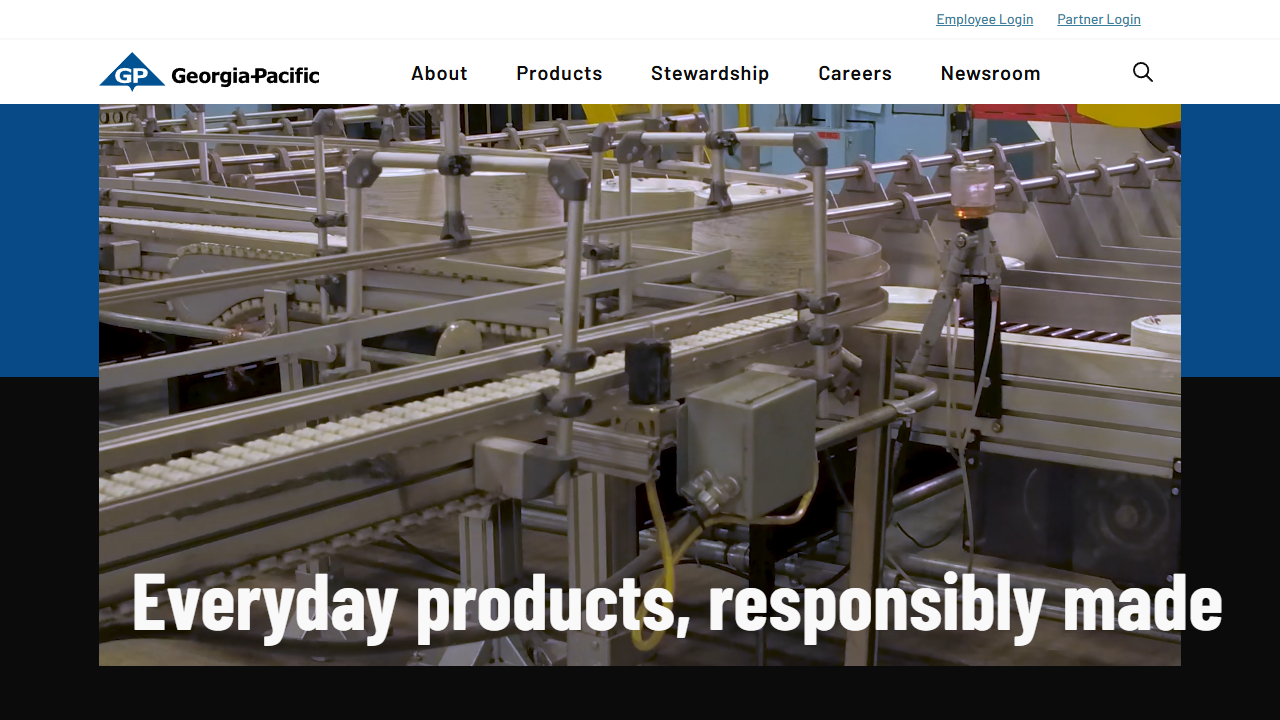
Georgia-Pacific's manufacturing process begins with sustainable forest management.
The company owns or manages millions of acres of timberland, using practices that ensure forests regenerate faster than they're harvested.
Trees are harvested using selective cutting methods that preserve biodiversity.
At the mill, logs are debarked and chipped, then cooked in chemical solutions to separate fibers.
The resulting pulp is washed, bleached (using oxygen-based bleaching to minimize environmental impact), and formed into paper products.
For building products like gypsum wallboard, the process involves mining natural gypsum or capturing it from flue gas at power plants, mixing it with additives, sandwiching it between paper facings, then cutting and drying the boards.
Quality control is rigorous at every stage, ensuring products meet or exceed industry standards.