Corn-Fed American Manufacturing
"From John Deere's steel horses to Maytag's dependable appliances—discover Iowa's tradition of building things that last."
Where Cornfields Meet Industry
Iowa is America distilled to its essence: fertile soil, honest work, and the understanding that what you build must withstand the test of time. This is the heartland where farmers feed the world, where manufacturing isn't just industry—it's a way of life shaped by seasons and the knowledge that your reputation depends on every product that carries your name. From the steel that carved America's prairies to the appliances that warmed American homes, Iowa brands share a common DNA: relentless focus on durability, service, and the farmer's work ethic. In a state where the horizon stretches endlessly and values run deep, these six stories represent the soul of American manufacturing—unpretentious, uncompromising, and utterly reliable.
Maytag
"Premium appliances built for reliability and performance since 1893."
The Founder's Vision
In 1893, Frederick Maytag saw something that would change laundry forever: farmers' wives scrubbing clothes on washboards, their hands chapped and raw from lye soap and hard work.
As a farmer himself, he understood their frustration.
So he started building wooden hand washers—simple devices that made laundry less of a chore and more of a manageable task.
But Maytag wasn't satisfied with 'good enough.' He obssessed over every detail: the speed of the agitator, the strength of the gears, the durability of the bearings.
When electric washers became possible, Maytag was ready, building machines that didn't just wash clothes but actually cleaned them.
Through the Depression, wars, and economic booms, Maytag maintained its reputation for quality.
They could have cut corners, chased cheap labor, or compromised on materials.
Instead, they chose a different path: build appliances so reliable that Maytag becomes the brand people trust with their most precious belongings.
A Commitment to Quality
Building appliances that last 20+ years requires a manufacturing philosophy that values substance over shortcuts.
Maytag begins with thick, heavy-gauge steel that's powder-coated for durability—the kind of finish that resists chips, scratches, and corrosion.
Internal components are over-engineered: motors with more copper than necessary, pumps with reinforced housings, belts made to industrial specifications.
During assembly, each appliance is tested multiple times: electrical systems are checked, fill cycles are verified, agitation patterns are confirmed.
Quality control isn't an afterthought—it's built into every step.
Components are sourced from suppliers who understand Maytag's standards: no cheap parts, no 'good enough' materials.
The result is appliances that don't just meet specifications—they exceed them, consistently.
Because Maytag knows that when your washing machine breaks down at 11 PM with a load of baby clothes, you need it to work.
Pioneer Seeds
"Leading seed genetics company feeding the world through agricultural innovation."

The Founder's Vision
In 1926, Henry Wallace had a radical idea: what if we could breed corn that was immune to the diseases that devastated Midwestern farms? What if we could develop varieties that yielded more grain per acre, fed more people, and made farmers more prosperous? Together with his brothers, he founded Pioneer Hi-Bred with a simple mission: develop the best corn seed possible.
They started small—testing varieties in Iowa fields, measuring yields, studying plant genetics when genetics was still a young science.
What separated Pioneer from competitors wasn't just better seeds—it was better service.
They sent agronomists to work with farmers, sharing knowledge that helped them maximize yields.
They invested in research facilities that pushed the boundaries of what was possible.
When drought struck or pests attacked, Pioneer farmers had an advantage.
Today, Pioneer continues to innovate, but always with the same goal: help farmers feed the world.
After all, good seed is just the beginning—good service makes all the difference.
A Commitment to Quality
Creating seeds that can feed the world requires a process that's part science, part art, and part farming expertise.
Pioneer begins with thousands of parent lines—genetic material that's been selected, tested, and refined over decades.
Each breeding program is tailored to specific regions: drought tolerance for the Great Plains, disease resistance for the Southeast, high yield potential for the Corn Belt.
Controlled crosses are made in isolation plots, where male plants are prevented from cross-pollinating except with selected females.
The resulting seeds are planted in test plots across multiple states, where they're evaluated for yield, standability, drought tolerance, and dozens of other traits.
Only the top 1-2% of hybrids make it to commercial production.
Production fields are monitored obsessively: rogue plants are removed, purity is tested multiple times, and harvest timing is optimized for seed quality.
It's a process that takes 8-10 years from initial cross to commercial hybrid, but results in seeds that can feed families for generations.
Amana
"Quality appliances and furniture crafted in the heartland with German precision."
A Living Tradition
In the 1850s, a group of German Pietists established seven villages in Iowa, united by shared values: cooperation, craftsmanship, and the belief that work is a form of prayer.
They called their settlement the Amana Colonies, and it became famous for furniture, woolens, and tools made with Old World precision.
In 1934, facing economic pressures, the community made a bold decision: start a manufacturing company that could compete in the modern world while honoring their traditional values.
Amana Appliances was born.
They brought German engineering to American homes, building appliances that reflected their values: solid construction, honest materials, and the understanding that products should be built to last for generations.
When GE acquired Amana, they preserved what made it special: that distinctive blend of American practicality and European craftsmanship that makes Amana appliances beloved by families who demand quality.
Innovation Meets Craftsmanship
Creating appliances worthy of the Amana name requires processes that honor both German engineering and American innovation.
Manufacturing begins with heavy-gauge steel that's fabricated using precision techniques developed over generations.
Components are assembled by skilled technicians who understand that every connection, every weld, every seal must meet Amana's exacting standards.
The famous Amana Radarange microwave, which revolutionized American kitchens, required hundreds of prototype tests to perfect the magnetron design and cavity construction.
Each appliance undergoes rigorous quality testing: temperature cycling to simulate years of use, stress testing on hinges and door mechanisms, electrical testing that exceeds industry standards.
Quality control is integrated throughout the process, not added at the end.
It's a philosophy that says if something's worth making, it's worth making right—the first time, every time.
Because Amana knows that families trust their appliances with their most precious possessions.
Lennox
"Premium heating and cooling systems delivering comfort since 1895."
The Founder's Vision
In 1895, David Lennox was an inventor in a small Iowa town, watching families struggle with heating their homes during brutal winters.
He had a vision: create a heating system so efficient, so reliable, that no family would ever be cold in their own home again.
What started with an improved steel furnace evolved into something much more: a commitment to comfort that extends beyond temperature to include air quality, energy efficiency, and peace of mind.
Through two World Wars, oil crises, and technological revolutions, Lennox never lost sight of their mission: create the most comfortable indoor environments possible.
When air conditioning became essential, Lennox was ready.
When energy efficiency became critical, Lennox innovated.
Today, they continue to push boundaries, but always with the same goal: make homes more comfortable places to live.
Because everyone deserves a comfortable home.
A Commitment to Quality
Creating comfort requires precision engineering and attention to details that most people never think about.
Lennox begins with research—studying how heat moves, how air flows, how to balance efficiency with performance.
Heat exchangers are fabricated from premium materials and tested to ensure they transfer heat efficiently while resisting corrosion.
Compressors are engineered to run smoothly and quietly, with advanced diagnostics that can predict maintenance needs before problems occur.
Sheet metal components are formed using precision equipment that ensures proper airflow and structural integrity.
Each system is charged with refrigerant using precision gauges that measure to thousandths of a pound.
Assembly is done by technicians who understand that comfort is about more than temperature—it's about balance, consistency, and reliability.
Before shipping, systems undergo comprehensive testing: heat exchanger testing, airflow measurement, electrical system verification.
It's manufacturing where quality is engineered in, not inspected in.
John Deere
"Legendary agricultural machinery and equipment powering American farming."
The Founder's Vision
In 1837, a blacksmith named John Deere had a problem: the prairie sod of Illinois was so thick and sticky that wooden plows couldn't cut through it.
So he took a piece of steel—a saw blade, actually—and forged it into the first successful steel plow.
The breakthrough wasn't just the steel—it was understanding that farmers needed equipment designed for American conditions, not just European imports.
That spirit of innovation defined John Deere for over 180 years.
When farmers needed better harvesters, John Deere built them.
When agriculture mechanized, John Deere led the way.
When GPS guidance became possible it standard, John Deere made.
Today, their tractors can drive themselves, their combines can adjust to conditions automatically, and their equipment feeds the world.
But underneath all the technology, John Deere remains true to its founder's vision: build equipment that helps farmers work the land productively, profitably, sustainably.
The Art of Handcrafted Excellence
Building machines that can harvest a year's worth of food in a few weeks requires manufacturing processes that are as advanced as they are precise.
John Deere begins with steel—specially formulated alloys that provide strength without excessive weight.
Components are forged using techniques that align the grain structure for maximum durability, then machined to tolerances measured in thousandths of an inch.
The assembly process is a marvel of coordination: transmission cases move through stations where gears are installed, tested, and verified; hydraulic systems are assembled and pressure-tested to ensure they can handle the loads required for heavy field work; engines are run-in and tested for power output and emissions compliance.
Quality control is integrated throughout: ultrasonic testing catches internal flaws, coordinate measuring machines verify complex geometries, and end-of-line testing ensures every machine meets John Deere's standards.
It's manufacturing where precision meets productivity, resulting in equipment that can handle the toughest conditions.
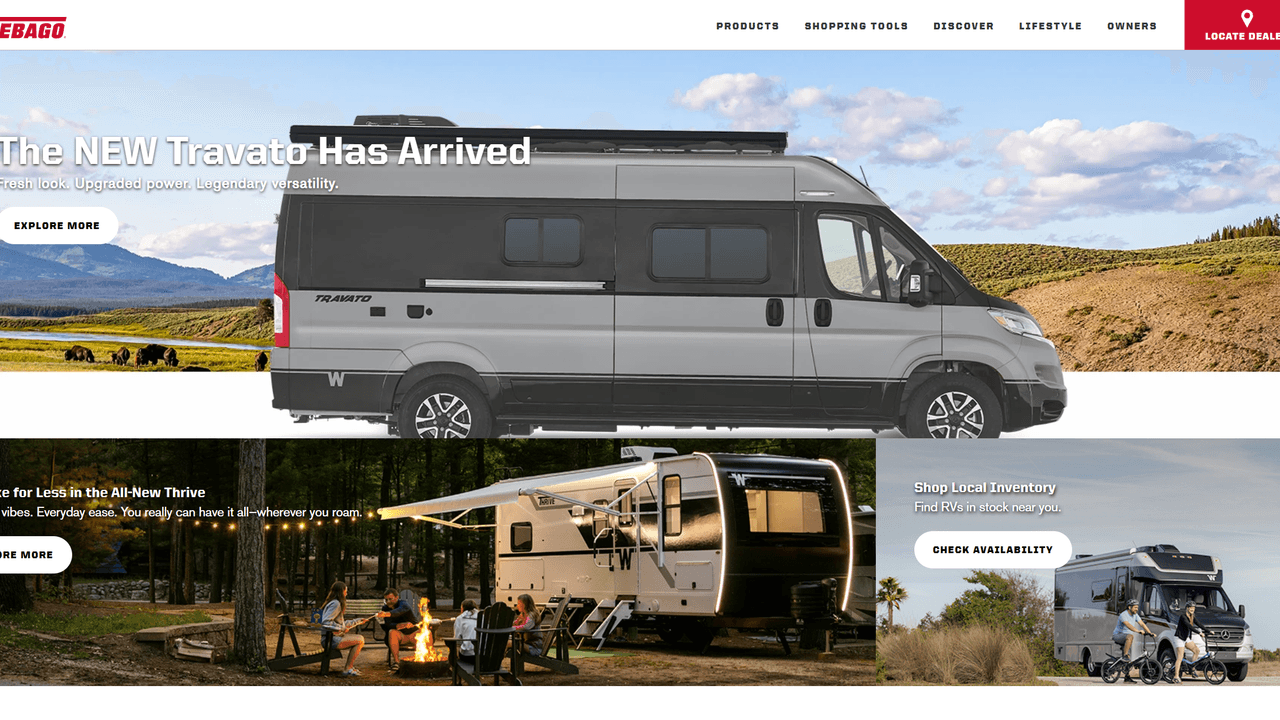
Winnebago
"America's favorite motorhomes, built for adventure and comfort since 1958."
The Founder's Vision
In 1958, a group of Iowans had a vision: what if families could explore America in comfort, with all the conveniences of home following them down the highway? They started by converting school buses into travel trailers, creating rolling homes that let families see the country on their own terms.
Word spread quickly—here was a way to travel that didn't mean sacrificing comfort or breaking the bank.
As the company grew, so did its reputation for quality and innovation.
When Americans wanted more luxurious motorhomes, Winnebago built them.
When they demanded better fuel efficiency, Winnebago listened.
When they wanted technology that made travel easier, Winnebago delivered.
Today, Winnebago continues to innovate, but always with the same mission: help families create memories on the open road.
Because the best vacations aren't destinations—they're journeys shared with people you love.
How It's Made
Creating homes on wheels requires a manufacturing philosophy that balances automotive engineering with residential construction.
Winnebago begins with chassis selection—working with Ford, GM, and Freightliner to create platforms that provide both performance and comfort.
The body construction is where automotive meets architecture: structural walls are built with composite materials that provide strength while maintaining fuel efficiency, while residential-grade insulation ensures comfort in any climate.
Electrical systems are engineered to code standards that exceed many houses: 12-volt DC for lighting and appliances, 120-volt AC for air conditioning and outlets, with inverter systems that allow off-grid camping.
Plumbing systems use PEX tubing and premium fixtures designed for mobile applications.
Each coach undergoes extensive testing: structural integrity testing, electrical verification, plumbing pressure testing, and road testing that simulates thousands of miles of travel.
It's manufacturing where every detail matters, because when you're 2,000 miles from home, your motorhome has to work perfectly.