Heart of America, Made to Last
"From golden wheat fields to blue skies—discover the craftsmen and manufacturers keeping Kansas's industrial heritage alive and thriving."
Where America's Breadbasket Meets Innovation
In Kansas, where the prairie stretches to the horizon and golden wheat waves in the wind, manufacturing isn't just business—it's a way of life passed down through generations. From the meatpacking plants that fed America during two world wars, to the aircraft factories that built the planes that won the skies, Kansas has always been the quiet powerhouse of American industry. Today, in workshops and factories across the Sunflower State, a new generation of makers continues this tradition. In Abilene, master chocolatiers hand-dip caramels using techniques perfected over a century. In Manhattan, engineers design agricultural equipment that feeds the world. In Wichita, the air Capital of the World, craftspeople build aircraft that soar above the clouds. These six brands represent the soul of Kansas craftsmanship: uncompromising quality, unshakeable values, and an understanding that what we make today becomes tomorrow's heritage. Every product carries with it the strength of the prairie, the resilience of the people, and the promise that American manufacturing is alive and well in the heart of America.
Kansas City Steak Company
"Premium dry-aged steaks from Kansas beef, dry-aged for 28 days and hand-cut to perfection."
The Founder's Vision
In 1952, when most steakhouses were using gas grills and rushing cooks through training, the founders of Kansas City Steak Company made a radical decision: they would treat steak-cutting like an art form.
Based in the historic Stockyards District, where cattle had been arriving by rail since the 1880s, the company understood that Kansas beef was already legendary—they just needed to showcase it properly.
The breakthrough came when they discovered that aging beef in controlled humidity and temperature for 28 days could concentrate flavors and tenderize meat naturally, without chemicals or shortcuts.
But aging was just the beginning.
They insisted that every steak be hand-cut by artisans who could read the grain in each piece of meat, understanding how the muscle fibers ran and where to make each cut for maximum tenderness.
These weren't just butchers—they were craftsmen who took pride in their ability to select and cut steaks that would create unforgettable meals.
Today, Kansas City Steak Company ships their signature dry-aged steaks to fine restaurants and discerning home cooks nationwide, but the process remains unchanged: hand-selected, dry-aged, and hand-cut the same way it was done 70 years ago.
The Art of Handcrafted Excellence
The steak-making process at Kansas City Steak Company begins with sourcing the finest Kansas beef, typically from cattle that have been grain-fed in the state's rolling hills for 180 days.
The beef arrives as primals (large cuts from which steaks are later cut) and immediately enters the aging room, where temperature is held at 34-38°F with 80-85% humidity.
Over 28 days, natural enzymes break down muscle fibers, concentrating flavors and creating the tender texture that makes dry-aged steak legendary.
The aging process is monitored daily, with each primal turned and inspected to ensure even aging.
After aging, the real artistry begins: skilled steak cutters examine each primal, reading the marbling patterns and muscle structure to determine optimal cutting lines.
Using long, razor-sharp knives, they hand-cut each steak, a process that can't be rushed because each piece is unique.
The steaks are then trimmed, with craftsmen removing excess fat while preserving the intramuscular marbling that adds flavor.
Each steak is weighed and labeled with its exact cut, weight, and aging date.
The final step is packaging: steaks are wrapped in butcher paper that allows the meat to breathe while protecting it, then packed in insulated containers with gel packs for shipping.
Russell Stover Candies
"Hand-dipped chocolates and caramels made in Kansas using traditional recipes since 1923."

The Founder's Vision
In 1923, during the depths of the Great Depression when most businesses were failing, Russell Stover opened a small chocolate shop in Denver with a simple promise: make the finest chocolates possible and never compromise on quality.
When World War II threatened to derail his business, Stover made another bold decision—he moved the entire operation to Abilene, Kansas, a town that offered stability, reliable workers, and freedom from the labor shortages affecting coastal cities.
The move proved prophetic.
In Kansas, Stover found not just a home for his company, but a community that understood the value of honest work and quality craftsmanship.
Today, Russell Stover's Abilene facility is one of the largest chocolate factories in America, but it still uses the same hand-dipping techniques that Russell developed in that first tiny shop.
The company's signature chocolates—alligators, Santas, and pecan delights—are still made the old-fashioned way: by hand, in small batches, with ingredients sourced from around the world and assembled by craftspeople who take pride in every piece.
What started as a Depression-era dream has become an American institution, proving that quality and tradition can survive and thrive in the heartland.
The Art of Handcrafted Excellence
The chocolate-making process at Russell Stover's Abilene facility is a fascinating blend of old-world craftsmanship and modern food safety standards.
It begins with sourcing the finest ingredients: cocoa beans from Ecuador and Venezuela, vanilla from Madagascar, pecans from Georgia, and butter from Wisconsin dairies.
The cocoa beans are roasted in traditional rotating drums, a process that takes 12-18 minutes at precisely 250°F to develop the complex flavor compounds that make great chocolate.
After roasting, the beans are cracked and winnowed to remove shells, leaving only the cocoa nibs.
These nibs are ground in stone melangeurs (grinding wheels) for up to 72 hours, creating smooth, velvety chocolate liquor.
Sugar and cocoa butter are added at specific intervals, with master chocolatiers tasting and adjusting the mixture until it reaches perfect balance.
For hand-dipping, centers are prepared daily: caramel is cooked in copper kettles to exactly 245°F, then cooled on marble slabs before being hand-rolled.
Truffles are made from ganache that's been aged 24 hours to develop optimal texture.
The actual dipping is done by hand, with experienced chocolatiers using long prongs to dip each piece in tempered chocolate.
The chocolate must be at exactly 88-90°F for proper tempering, which creates the glossy finish and satisfying snap.
Each piece is set on cooling belts that move through tunnels of precisely controlled temperature and humidity.
Great Plains Manufacturing
"Agricultural equipment and implements built in Kansas for America's farmers."

The Founder's Vision
In 1976, when the farm crisis was decimating rural communities across America, three brothers in Salina, Kansas had a crazy idea: instead of giving up on farming, they'd build better tools for farmers who refused to quit.
Great Plains Manufacturing started in a converted garage with a single welding machine and a commitment to making agricultural equipment that could withstand the punishing conditions of the Great Plains.
Their first product was a revolutionary tillage tool designed to break up the hardpan soil common in central Kansas, but it was the company's dedication to farmer feedback that set them apart.
Instead of designing in boardrooms, the founders spent days in fields, watching how farmers actually worked and listening to their frustrations with existing equipment.
This customer-driven approach led to breakthrough innovations: implements that folded smaller for easier transport, components that could be repaired in the field without specialized tools, and designs that reduced fuel consumption by up to 30%.
Today, Great Plains is one of the largest privately-held agricultural equipment manufacturers in America, but they've never forgotten their roots.
Every piece of equipment is still designed with input from Kansas farmers, built in Salina using American steel, and tested in the same fields that inspired their creation.
How It's Made
The manufacturing process at Great Plains is a study in precision engineering and farmer-focused design.
It begins with computer-aided design (CAD) software, where engineers model implements in 3D, simulating how they'll perform in different soil conditions and terrains.
Prototypes are built and tested in the company's 160-acre test facility, where various soil types allow engineers to refine designs before production.
Steel arrives from Midwestern mills and is cut using CNC laser cutters that achieve tolerances within 0.005 inches—critical for implements that must work in perfect harmony with moving tractor components.
The cutting process uses nesting software to minimize waste, with leftover steel recycled back into the melt.
After cutting, components move to fabrication shops where they're bent, welded, and assembled.
Welding is done by certified welders using both automated robotic welders for high-volume components and manual welders for custom or low-volume parts.
Every weld is inspected using ultrasonic testing to ensure structural integrity.
The finishing process includes sandblasting to prepare surfaces for painting, then application of a powder-coat finish that's cured in ovens at 400°F for maximum durability.
Final assembly happens on moving assembly lines where each implement is built by teams of specialists, with each person responsible for a specific subsystem.
Before shipping, every implement is test-assembled to ensure all components fit properly and function as designed.
Wichita Aviation
"Custom aircraft components and retrofit services for general aviation."

A Living Tradition
In 1915, when the airplane was still a dangerous experiment, a group of visionary entrepreneurs chose Wichita, Kansas as the site for America's first dedicated aircraft manufacturing facility.
They chose wisely: the city's location in the heart of America, surrounded by wide-open spaces for testing and a culture that valued innovation, proved perfect for aviation development.
Today, Wichita is known as the 'Air Capital of the World,' home to major aircraft manufacturers and hundreds of specialized aviation companies.
Wichita Aviation represents the best of this tradition: a company that builds custom aircraft components and performs retrofit services for everything from single-engine Cessnas to twin-engine business jets.
What sets Wichita Aviation apart is their understanding that aircraft don't just need to fly—they need to inspire confidence in pilots who trust their lives to machines built in Kansas.
Every component is crafted to exceeding FAA standards, with craftspeople who have grown up in the aviation industry and understand that there's no room for compromise when lives are at stake.
From custom instrument panels to complete cabin interiors, Wichita Aviation proves that American precision engineering and old-school craftsmanship can coexist in the modern aviation industry.
The Art of Handcrafted Excellence
The aircraft manufacturing process at Wichita Aviation is governed by strict Federal Aviation Administration (FAA) regulations and represents the pinnacle of precision engineering.
It begins with detailed engineering drawings that must be approved by FAA Designated Engineering Representatives (DERs).
Materials are sourced from approved suppliers and traceable to certified mills—every piece of aluminum, steel, and composite material comes with certificates of compliance.
For metal components, CNC machining creates parts with tolerances within thousandths of an inch.
The machining process uses advanced multi-axis machines that can create complex geometries in single setups, reducing the chance of dimensional errors.
After machining, parts are hand-finished by experienced technicians who check each dimension with precision measuring tools before assembly.
For composite components (fiberglass and carbon fiber), layup occurs in climate-controlled clean rooms where temperature and humidity are precisely controlled.
Composite materials are hand-laid using templates and checked for proper fiber orientation—critical for strength.
Parts are cured in autoclaves (high-pressure ovens) at 250°F and 50 PSI, creating molecular bonds stronger than the original materials.
Every step is documented in detailed traveler paperwork that follows each component through production.
Final assembly includes systems integration: running wires, installing avionics, and connecting hydraulic lines.
Before delivery, every aircraft undergoes a series of ground tests and a first flight inspection by FAA-certified mechanics.
Kansas City Bolt & Nut
"Industrial fasteners and hardware made in Kansas for American manufacturing."

The Story Behind the Brand
In 1941, when America was mobilizing for World War II and couldn't afford to rely on imported hardware for its ships, planes, and tanks, Kansas City Bolt & Nut was born with a mission: ensure American manufacturers never lacked for quality fasteners.
Founded by three immigrant families who understood that the machinery of war depended on the smallest components, the company grew from a small workshop producing bolts for local factories to one of the Midwest's most trusted suppliers of industrial hardware.
What distinguished Kansas City Bolt from the beginning was their obsession with consistency: every bolt had to be exactly like every other bolt, every nut had to thread perfectly with every bolt, and every batch had to meet specifications written in blood during wartime production.
This commitment to precision made them the go-to supplier for Kansas's growing aircraft industry and later for the agricultural equipment manufacturers that powered America's post-war boom.
Today, while other fastener companies have moved production overseas to chase lower costs, Kansas City Bolt still makes the majority of their products in Kansas, using American steel and the same uncompromising quality standards that guided them through 80 years of American manufacturing.
Time-Honored Techniques
The bolt and nut manufacturing process at Kansas City Bolt is a marriage of traditional metallurgy and modern precision engineering.
It begins with steel rod sourced from domestic mills, typically AISI 1045 medium carbon steel for its optimal balance of strength and ductility.
The steel arrives as coils weighing up to 3,000 pounds, which are fed into cold heading machines that form the head of the bolt without removing material (unlike machining, which cuts away excess).
The cold heading process uses dies and punches to squeeze the steel into shape at room temperature, a method that actually strengthens the material by aligning its grain structure.
After heading, the bolts are threaded using rolling dies that press threads into the shank rather than cutting them, again strengthening the material.
The threading process uses CNC-controlled machines that can produce threads with tolerances within 0.0005 inches.
Nuts are formed from hexagonal steel blanks on similar cold heading machines, then tapped with internal threads using precision taps.
Surface treatment is critical for corrosion resistance: bolts are zinc-plated using electroplating, a process that deposits a thin layer of zinc to protect against rust.
Quality control includes random sampling of every batch, with bolts tested for tensile strength, yield strength, and dimensional accuracy.
Threads are checked with calibrated go/no-go gauges, and surface finish is inspected for defects.
Every shipment includes certified test reports documenting the mechanical properties of the steel used.
Prairie Farms Dairy
"Farm-fresh dairy products from Kansas dairy farms, processed in Hillsboro."
A Living Tradition
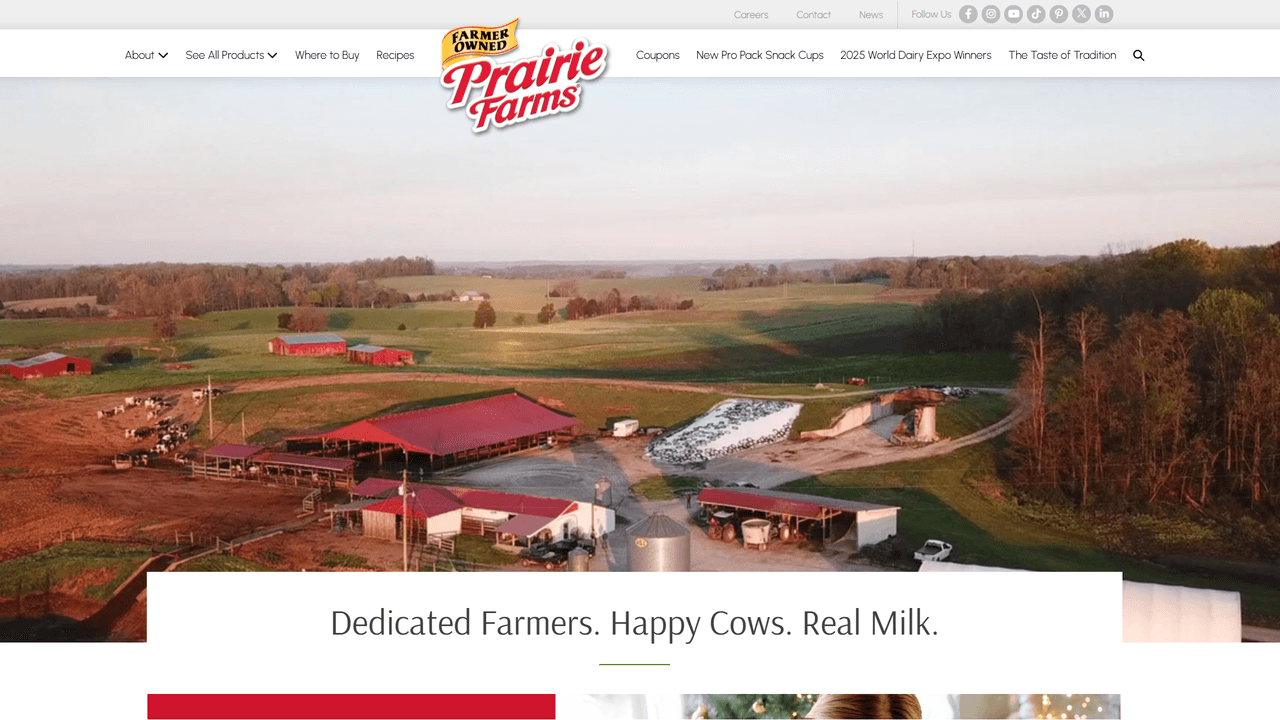
In the rolling hills of central Kansas, where black walnut trees shade pastures and Holstein cows graze on prairie grass that hasn't changed since the days of the Chisholm Trail, Prairie Farms Dairy represents the continuation of a tradition that built America: family farming.
Founded in 1968 when three generations of the Petersen family decided to go from selling milk at their farm gate to processing it for stores across Kansas, Prairie Farms has always understood that great dairy products start with happy, healthy cows.
The Petersen's philosophy was simple: treat your cows well, and they'll produce the richest, creamiest milk.
This meant pasture-raising their herd, giving the animals room to roam and graze naturally, and investing in modern milking facilities that kept stress low and quality high.
When Prairie Farms opened their Hillsboro processing plant, they brought the same attention to animal husbandry to milk processing.
Milk arrives from member farms within hours of milking, is tested for quality and safety at every step, and is processed using techniques that preserve the natural taste and nutritional value that make Kansas dairy special.
Today, Prairie Farms supplies milk, cheese, and ice cream to stores throughout the Midwest, but they've never forgotten that their success depends on the relationship between farmers, cows, and the land they share.
A Commitment to Quality
The dairy processing at Prairie Farms Dairy is a careful balance of modern food safety technology and time-tested techniques that preserve milk's natural goodness.
Milk arrives from member farms in insulated tanker trucks that maintain it at 38°F, preventing bacterial growth while preserving freshness.
Each batch is tested immediately upon arrival for bacterial count, somatic cells (a sign of cow health), and antibiotic residues—any milk that fails these tests is rejected and returned to the farm.
The milk then undergoes clarification and separation: centrifugal clarifiers remove dirt and debris, while separators spin the milk at 6,000 RPM to separate cream from skim milk.
This allows Prairie Farms to create different products (whole milk, 2%, skim) with exact butterfat percentages.
The milk is homogenized using high-pressure homogenizers that break up fat globules, creating a consistent product that won't separate.
Pasteurization is done using High Temperature Short Time (HTST) processing: milk is heated to 161°F for 15 seconds, effectively killing harmful bacteria while preserving milk's flavor and nutritional value.
For cheese production, milk is cultured with specific bacterial strains that acidify it, then rennet is added to cause coagulation.
The curd is cut, cooked, and stirred to release whey, then pressed into wheels or blocks.
Cheese ages in controlled humidity and temperature rooms for periods ranging from 60 days (for cheddar) to over a year (for aged varieties).
All products are packaged in the plant's on-site packaging facility using equipment that minimizes exposure to air and light.