Innovation Born in the Bay State
"From Harvard's hallowed halls to MIT's cutting-edge labs—Massachusetts leads America in innovation and ingenuity."
Where Ideas Become Industries
Massachusetts has never been a state that follows—it leads. From the revolutionary spirit that sparked a nation to the technological innovations that power today's world, the Bay State has always been where future is made. In labs and workshops across the Commonwealth, today's makers are writing the next chapter of American innovation. Whether it's New Balance's athletic wear tested on Boston's marathon route, or Polaroid cameras capturing memories in an instant, these six brands represent the soul of Massachusetts craftsmanship. Here, tradition isn't something to preserve—it's something to build upon, combine with cutting-edge science, and use to create products that change how we live, work, and play.
Harvard Medical School
"World-renowned medical research and innovation hub advancing healthcare."

Innovation Born from Necessity
Since 1782, Harvard Medical School has been at the forefront of medical innovation, training generations of physicians and researchers who have shaped modern healthcare.
From the discovery of anesthesia to the development of the first artificial heart, Harvard's labs have been the birthplace of medical miracles.
Today, the school continues to push boundaries, combining centuries of knowledge with cutting-edge technology to tackle humanity's greatest health challenges.
Their work extends beyond the lab—translating research into real-world treatments that save lives and improve quality of life for millions worldwide.
Innovation Meets Craftsmanship
Harvard Medical School's approach to innovation is methodical yet revolutionary.
Their research begins with fundamental questions about human biology and disease, pursued through rigorous scientific inquiry in state-of-the-art facilities.
Collaborations span multiple disciplines, bringing together biologists, engineers, computer scientists, and clinicians to tackle complex medical challenges.
The translation process from discovery to treatment involves extensive clinical trials, partnerships with leading hospitals, and careful regulatory review.
Every breakthrough follows a path paved by curiosity, collaboration, and an unwavering commitment to improving human health.
MIT
"Pioneering research and technology innovation since 1861."
Innovation Born from Necessity
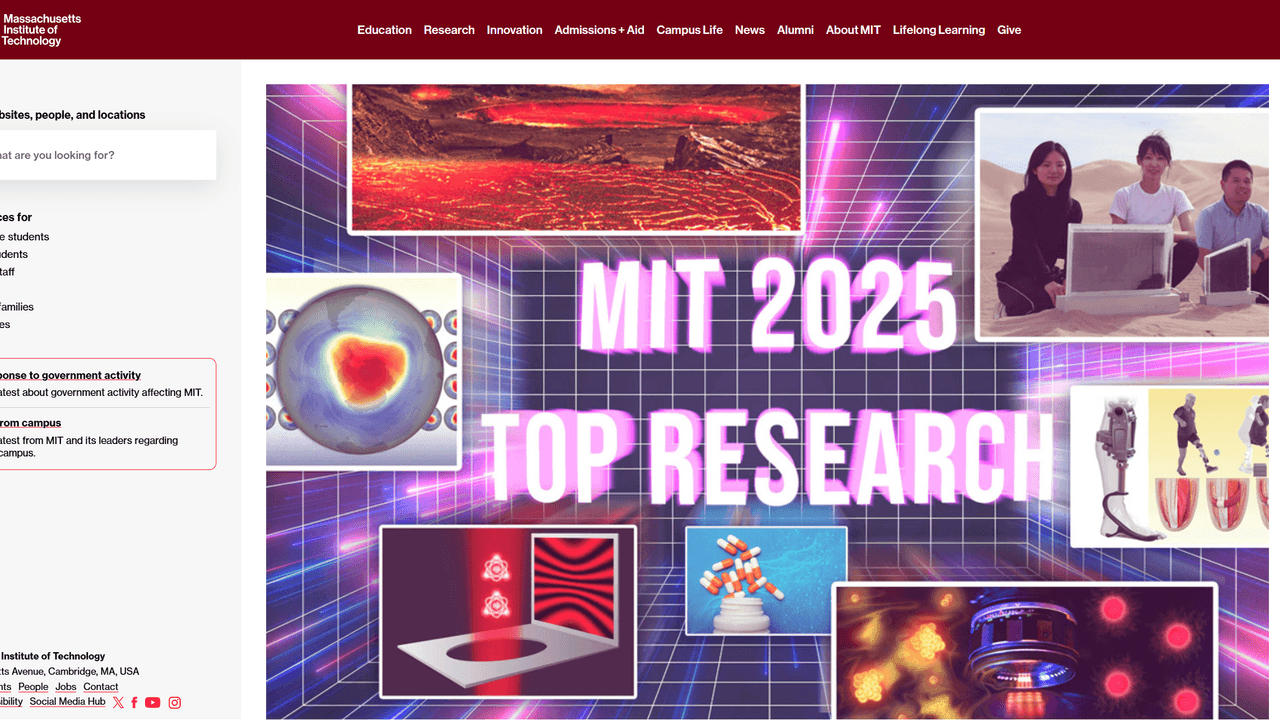
MIT was born from a radical idea: that education should be hands-on, that students should learn by doing, and that the best classroom is a workshop filled with tools and possibilities.
This philosophy has produced some of America's most transformative innovations—from the development of the first digital computer to the creation of the World Wide Web protocols.
MIT's researchers and alumni have founded more than 30,000 active companies, employing millions and generating trillions in revenue.
But MIT's true magic isn't in the numbers—it's in the mindset of 'mens et manus'—mind and hand working together to solve real problems.
Innovation Meets Craftsmanship
MIT's innovation process is unique: start with a problem that matters, then build the solution from the ground up.
Research begins in interdisciplinary labs where engineers collaborate with scientists, who work alongside economists and artists.
The Media Lab model—where researchers have the freedom to pursue 'unconventional research'—has produced breakthrough technologies from e-ink to wearable computing.
Prototyping happens in world-class facilities like the MIT.nano, where scientists can manipulate matter at the atomic level.
The goal is never just to publish a paper—it's to create technology that changes how we live.
New Balance
"Performance athletic footwear and apparel crafted for champions."

The Founder's Vision
In 1906, when James and William Emmet New Balance set out to create arch supports, they couldn't have imagined they'd one day outfit Olympic champions and marathon legends.
What started as a small orthopedic shoe company in Boston has evolved into one of America's most respected athletic brands.
Unlike competitors who moved production overseas decades ago, New Balance has always maintained a significant manufacturing presence in New England.
They've proven that quality isn't sacrificed for efficiency—that handcrafted attention to detail still matters when you're creating shoes that help athletes achieve greatness.
From Boston Marathon champions to everyday runners, New Balance footwear is built for those who demand excellence.
A Commitment to Quality
Every New Balance shoe begins with understanding the human foot—how it moves, how it sweats, how it strikes the ground.
Their Boston-based R&D facility houses biomechanics labs where athletes test prototypes under conditions that mimic real-world use.
Materials are carefully selected for performance: proprietary foams that return energy, breathable mesh that adapts to foot shape, and rubber compounds that grip any surface.
Manufacturing happens in New England facilities where skilled craftspeople can pay attention to details that machines miss.
Each shoe is built on lasts (foot-shaped molds) that have been refined over decades, ensuring the perfect fit and performance.
Bose
"Premium audio equipment delivering lifelike sound experiences."
The Founder's Vision
Dr.
Amar Bose started with a simple question that would revolutionize how we listen: why do concert halls sound so much better than living rooms? This curiosity led to decades of research into psychoacoustics—the science of how humans perceive sound.
The result was a company that refused to compromise on audio quality.
From the first Bose speaker system that could reproduce realistic stereo sound from a single enclosure, to noise-canceling headphones that could silence jet engines, Bose has consistently pushed the boundaries of what's possible in audio.
Their products aren't just speakers—they're gateways to emotional experiences, connecting us to music in ways that make hairs stand on end.
How It's Made
Bose's approach to audio engineering begins with listening—literally.
In anechoic chambers that absorb 99.9% of sound, engineers conduct detailed measurements of how audio reproduces in real spaces.
The goal isn't just accurate frequency response, but emotional impact: does this speaker make you feel like you're in the recording studio? Materials are chosen based on acoustic properties, not cost: proprietary speaker drivers, advanced cabinet designs, and custom electronics.
Every product undergoes extensive listening tests by trained ears and casual consumers alike, ensuring the sound matches the vision.
It's part science, part art, and entirely about the experience.
Polaroid
"Instant photography pioneer creating tangible memories."
The Story Behind the Brand
Edwin Land's daughter's simple question—'Why can't I see the picture right now?'—sparked an invention that would change how the world captures memories.
In 1947, Land unveiled the Polaroid camera at the Optical Society of America, demonstrating a camera that could produce a finished photograph in 60 seconds.
This wasn't just a technical achievement; it was a new way of relating to images.
Polaroid made photography accessible, immediate, and deeply personal.
From revolutionary sunglasses to instant cameras, Polaroid has always believed technology should enhance human experience, not complicate it.
The magic of watching a photo develop before your eyes never gets old.
Innovation Meets Craftsmanship
The Polaroid instant photography process is a marvel of chemical engineering and precise timing.
Each pack film contains a battery, negative, and positive pod with millions of micro-capsules of dye.
When the camera's rollers press down, they rupture these capsules at precisely timed intervals.
The dyes flow in a carefully choreographed dance: first the developers, then the dyes in a specific sequence—cyan, magenta, yellow—building up the image layer by layer.
Temperature, humidity, and timing all affect the final image, making each Polaroid unique.
It's chemistry and physics working together to create art.
W. L. Gore & Associates
"Innovative materials science company behind GORE-TEX fabric."

Innovation Born from Necessity
Bill Gore's 'aha moment' came in his basement in 1958: what if we could create materials with the properties of both plastic and metal? This question led to the discovery of ePTFE—expanded polytetrafluoroethylene—and the creation of a company culture unlike any other.
W.L.
Gore operates on 'lattice' structure where associates (not employees) have sponsors rather than bosses, where ideas can come from anywhere, and where the best solutions win regardless of their source.
This unique culture has produced innovations from GORE-TEX waterproof fabric used by mountaineers worldwide to medical devices that save lives.
At Gore, innovation isn't a department—it's a way of being.
Innovation Meets Craftsmanship
The creation of GORE-TEX is deceptively simple: take PTFE (Teflon), stretch it into a rope, then rapidly heat it so it expands into a microscopic maze of air pockets.
These pores are 20,000 times smaller than water droplets but 700 times larger than water vapor molecules, creating the 'perfect' membrane—waterproof yet breathable.
But perfecting this process took years of experimentation, precise temperature control, and specialized equipment.
The same science applies to Gore's medical devices: understanding how materials interact with human bodies, then engineering solutions at the molecular level.
Every innovation starts with understanding the fundamental physics or biology of a problem, then building a material solution from the atom up.