Where American Industry Was Born
"From Pittsburgh steel to Philadelphia craftsmanship, discover the brands that built America's manufacturing legacy."
The Birthplace of American Manufacturing
In Pennsylvania, where coal once fed the furnaces that powered America's industrial revolution, manufacturing isn't just about making things—it's about continuing a legacy. From the steel mills of Pittsburgh to the textile shops of the Lehigh Valley, from the Amish farms of Lancaster to the tech labs of Philadelphia, Pennsylvania has always been about combining old-world craftsmanship with new-world innovation. The brands featured here represent the breadth of Pennsylvania's manufacturing tradition: tools that are built to last a lifetime, toys that inspire creativity, and goods that are made with the understanding that quality is a responsibility, not a choice. Each product carries the weight of Pennsylvania's history: the belief that if you're going to make something for someone, it should be something you're proud of.
Crayola
"The world's leading manufacturer of creative expression tools for kids and artists."
Innovation Born from Necessity
In 1903, when Alice Binney and Edwin Binney created the first Crayola crayon from paraffin wax and pigment, they probably never imagined that their little company would become synonymous with childhood creativity.
But that's exactly what happened.
Today, from their factory in Easton, Pennsylvania, Crayola produces over 3 billion crayons annually—enough to circle the Earth 300 times if laid end to end.
What makes Crayola special isn't just the volume of crayons they produce; it's their understanding that creativity is sacred.
The company has developed over 300 crayon colors, each with a name that sparks imagination: 'Neon Carrot,' 'Razzle Dazzle,' 'Tickle Me Pink.' These aren't just colors—they're invitations to create worlds that exist only in a child's imagination.
Crayola's innovation extends beyond crayons to markers, colored pencils, and digital art tools, but the heart of the company remains the same: helping kids express themselves through color.
The Easton factory operates 24 hours a day, 5 days a week, with workers who understand that every crayon they make might be the one that inspires a child to become an artist, a designer, or simply someone who sees the world in color.
A Commitment to Quality
The crayon-making process at Crayola is a fascinating blend of art and science.
It begins with selecting paraffin wax—a petroleum derivative that's been refined to remove impurities that could affect color or safety.
The wax is melted in large kettles and mixed with precisely measured pigments, creating a slurry that's poured into heated molds.
Each mold contains 120 crayon cavities, and the process is so precise that every crayon weighs within 0.1 grams of the target weight.
The filled molds travel through a cooling tunnel where temperature is carefully controlled to ensure uniform solidification.
Once cooled, crayons are ejected from the molds and inspected for defects using high-speed cameras and laser sensors.
Any crayon that doesn't meet specifications is recycled back into the production process.
The finishing process involves applying labels using high-speed labelers that can apply 400 labels per minute.
But the most important part of the process is quality control: every batch of crayons is tested for color accuracy, break strength, and safety (Crayola crayons are non-toxic and meet or exceed all ASTM D-4236 standards).
The final step is packaging, where crayons are grouped by color families and loaded into boxes designed to protect them during shipping.
The Easton facility is one of the most automated in the industry, but it's the human touch—workers who understand that they're making more than crayons, they're making the tools of imagination—that makes Crayola special.
Zippo
"Iconic windproof lighters with a lifetime guarantee, manufactured in the USA since 1932."
The Story Behind the Brand
In 1932, on a cold winter night in Bradford, Pennsylvania, George G.
Blaisdell watched a friend struggle with a flimsy Austrian lighter that wouldn't stay lit in the wind.
That moment of frustration led to one of America's most iconic products: the Zippo lighter.
Blaisdell's solution was elegantly simple: create a lighter with a hinged lid that could be operated with one hand and a windproof design that would work in any weather.
The first Zippo lighter was made in Blaisdell's machine shop using a simple rectangular case with a distinctive 'click' when opened—a sound that's become as recognizable as the product itself.
Today, over 600 million Zippos have been sold, and the company still manufactures in the same building where the first lighter was created.
But Zippo is more than a lighter—it's a symbol of reliability, backed by an unconditional guarantee: 'It works or we fix it free, forever.' This guarantee isn't just marketing; Zippo's repair clinic in Bradford has a wall of lighters some dating back 80 years, all repaired and returned to working condition.
Zippos have been to the bottom of the ocean, the top of Mount Everest, and into space, always working when needed.
The 'click' of a Zippo opening has been heard in movies, on battlefields, and in countless moments of celebration, making it one of America's most recognizable sounds.
The Art of Handcrafted Excellence
The lighter-making process at Zippo is a testament to the power of continuous improvement and quality control.
It begins with brass or steel blanks that are drawn into cases using progressive dies—machines that shape metal in multiple steps to create the distinctive Zippo rectangle.
The case is then trimmed to exact dimensions and polished to a mirror finish using progressively finer abrasives.
The lid is attached using a hinge pin that's hand-fit to ensure the right amount of tension—tight enough to stay closed but loose enough to open with one finger.
The most critical component is the chimney insert, which creates the windproof chamber that allows the flame to burn steadily.
The insert is made from precision-machined brass and features a series of holes and channels that control airflow.
The ignition system uses a flint wheel that creates sparks when rotated, igniting the butane gas (Zippo switched from naphtha to butane in the 1950s).
The finishing process involves applying the iconic finish: brushed chrome, polished brass, or one of dozens of specialized coatings.
Each lighter is assembled by hand, with workers who have trained for months to ensure every component fits perfectly.
The final step is testing: every lighter is filled with fuel and tested to ensure it lights and burns properly.
Lighters that don't meet Zippo's standards are rejected and recycled.
The 'click' sound that makes Zippos famous is actually a registered trademark, created by specific tolerances in the hinge mechanism.
W.R. Case & Sons Cutlery Co.
"Traditional American pocket knives with proprietary steel blends since 1889."
A Living Tradition
W.R.
Case & Sons Cutlery Company is a heritage knife manufacturer based in Bradford, Pennsylvania, with roots dating back to 1889.
A subsidiary of Zippo Manufacturing Company since 1993, Case is synonymous with the traditional American pocket knife.
The company's manufacturing process is a blend of modern technology and hand-craftsmanship, involving over 160 manufacturing steps to produce a single knife.
Case is famous for its proprietary steel formulations, including Chrome Vanadium (CV) and Tru-Sharp™ Surgical Steel.
Recently, in response to supply chain constraints, Case reintroduced 1095 carbon steel, a material identical to that used in their early 20th-century blades, demonstrating the resilience of their domestic supply chain.
The knives feature handles made from diverse materials such as cattle bone (sourced from Brazil but processed in PA), stag antler, buffalo horn, and synthetic materials.
The 'tangled' history of Case involves moving to Bradford in 1905 to access better steel and skilled labor, a decision that cemented the region's reputation for cutlery.
Case knives are highly collectible, with the 'Tang Stamp' dating system allowing collectors to identify the year of production.
The Art of Handcrafted Excellence
The knife-making process at Case begins with precision forging of steel blanks to create the basic shape of each blade.
The blades are then ground to exacting specifications using automated grinding wheels, followed by hand-fitting of the blade to the handle scale.
A critical step is heat treatment, where blades are heated to precise temperatures and quenched in oil to achieve the optimal balance of hardness and flexibility.
The tempering process reduces brittleness while maintaining edge retention.
Handles are attached using brass pins and rivets, with synthetic handles receiving special UV treatment for durability.
The final assembly involves carefully fitting all components and testing the action of the blade—ensuring it opens smoothly and locks securely.
Each knife undergoes inspection for fit, finish, and sharpness.
The iconic 'Case' logo is stamped into the blade using precision dies, while handle materials receive laser engraving for authenticity.
Case's commitment to quality is evident in their testing protocols, where sample knives undergo rigorous durability tests including drop tests, edge retention tests, and corrosion resistance tests.
The result is a knife that's built to last generations, backed by the same commitment to American manufacturing that has defined Case for over a century.
Wendell August Forge
"Hand-hammered aluminum trays and ornaments, America's oldest forge since 1923."
A Living Tradition
Wendell August Forge, established in 1923, is America's oldest and largest forge, producing hand-hammered metal giftware in Grove City and Mercer, Pennsylvania.
The company preserves a dying art form where artisans, who are members of the United Steelworkers union, manually hammer complex designs into metal dies.
These dies are then used to shape aluminum, bronze, and copper into trays, plates, coasters, and Christmas ornaments.
The manufacturing process is incredibly labor-intensive and results in pieces where no two are exactly alike.
In 2010, a massive fire destroyed their historic production facility, but the company rebuilt and modernized, expanding their product lines to include officially licensed NFL merchandise.
This strategic pivot allowed them to apply traditional metalworking skills to modern sports memorabilia, widening their appeal.
Their products are often used as diplomatic gifts and corporate awards due to their high perceived value and indisputable American craftsmanship.
The forge represents the artistic side of Pennsylvania's metalworking legacy, transforming industrial materials into heirloom-quality home decor.
The Art of Handcrafted Excellence
The metalworking process at Wendell August Forge begins with hand-hammering designs into steel dies by skilled artisans who have trained for years to perfect their craft.
Each die captures the intricate details that will be transferred to the final product.
Aluminum sheets are then heated and pressed into these dies using hydraulic presses, creating the initial form of the tray or ornament.
The pressed pieces undergo a series of finishing processes, including trimming excess material, sanding to smooth edges, and polishing to achieve the signature luster.
For items like trays, additional steps include attaching handles and adding feet.
The most skilled artisans handle the fine details, using hammers and specialized tools to refine edges and enhance the hammered texture.
Color is added through a process called 'tone painting,' where artists hand-apply patinas and highlights to bring designs to life.
Each piece is individually inspected to ensure it meets Wendell August's exacting standards.
The company's NFL licensing program requires precise reproduction of team logos, demanding the highest level of craftsmanship.
This combination of industrial capability and artistic skill results in products that are both functional and decorative, suitable for both everyday use and special occasions.
The hand-forged nature means every piece carries the subtle variations that mark it as unique, a feature that collectors prize.
Crazy Aaron's Thinking Putty
"Silicone-based thinking putty with unique properties like magnetism and UV reactivity."
The Founder's Vision
Crazy Aaron's Thinking Putty, headquartered in Norristown, Pennsylvania, reinvented the toy putty category by introducing high-quality silicone-based compounds that never dry out.
Founder Aaron Muderick, a former software engineer, taught himself chemistry to develop proprietary formulas that allow for unique physical properties such as magnetism, color-changing heat sensitivity, and UV light reactivity.
Unlike many toy companies that offshore production to Asia, Crazy Aaron's manufactures all its putty in its Pennsylvania factory.
A core component of their business model is social inclusivity; the company partners with vocational centers to employ hundreds of individuals with intellectual and physical disabilities to assist in the manufacturing and packaging process.
This 'Made in USA' commitment ensures that the product meets strict safety standards (crucial for children's toys) and supports the local community.
The brand has grown from a niche office toy to a global phenomenon, yet it remains firmly rooted in PA, with a flagship retail experience in Norristown where customers can mix their own custom tins.
Innovation Meets Craftsmanship
The thinking putty production process begins with formulating proprietary silicone polymers in-house—a closely guarded secret process that determines the unique properties of each type of putty.
Specialized equipment blends base silicone compounds with colorants, additives, and effect particles (like magnetic iron filings for magnetic putty or thermochromic pigments for color-changing varieties).
The mixing process requires precise temperature control and timing to achieve the perfect consistency.
After mixing, the putty is extruded into logs and cut into individual portions using specialized cutting equipment.
Packaging is where social impact meets production efficiency; employees with special needs work alongside trained staff to inspect, label, and package the putty into its iconic metal tins.
Each tin is sealed to prevent drying and is labeled with detailed information about the specific properties.
Quality control involves testing for stretchiness, bounce, and effect activation.
For example, magnetic putty is tested to ensure it responds correctly to magnets, while UV-reactive putty is exposed to black light to verify color change.
The manufacturing facility maintains strict safety protocols appropriate for a children's product, with all materials meeting or exceeding ASTM F963 toy safety standards.
The company's commitment to local production allows for rapid prototyping and product development, enabling them to respond quickly to market trends and customer feedback.
American Trench
"American-made socks and outerwear, knit in Pennsylvania using domestic materials."
A Family Legacy
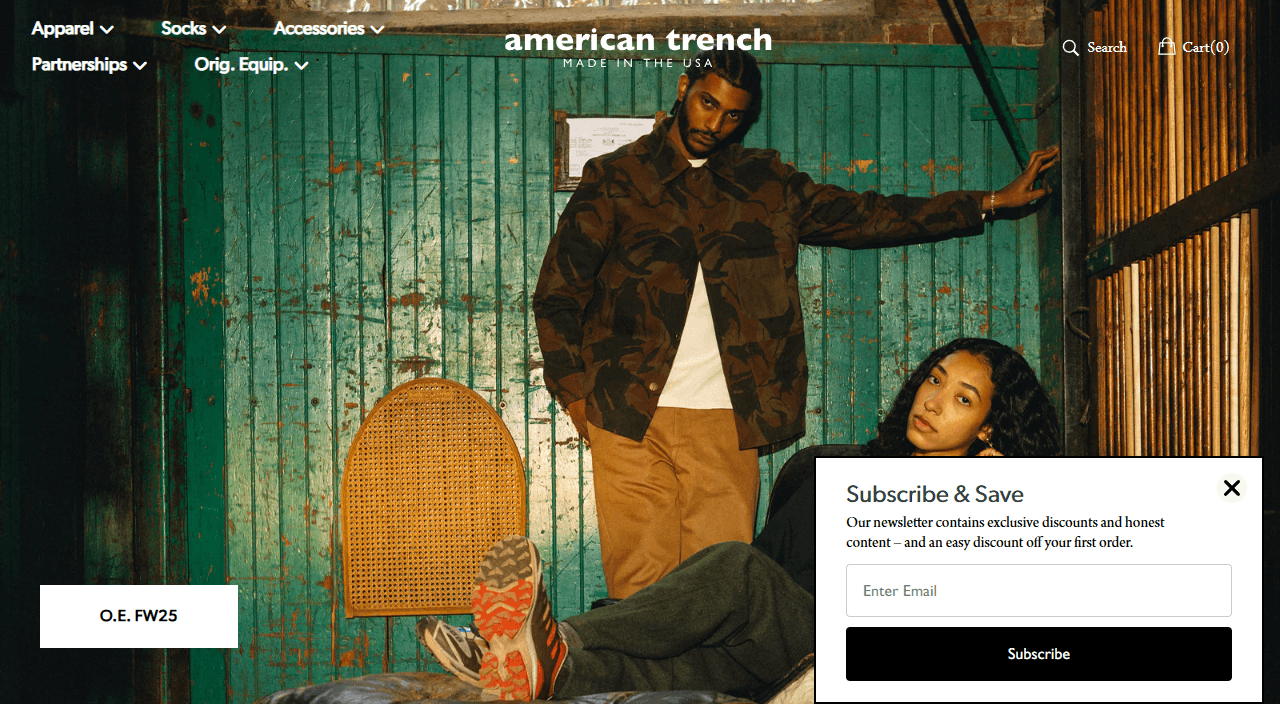
American Trench was founded in 2008 in Philadelphia with a singular mission: to produce a high-quality trench coat in the United States.
While they succeeded in that goal, the brand found broader success by expanding into accessories, particularly socks and knitwear.
American Trench operates on a networked manufacturing model, partnering with knitting mills across Pennsylvania (such as in Reading) and the Northeast to produce their goods.
Their best-selling 'Retro Stripe' socks are knit in Pennsylvania using American-grown cotton and wool.
The brand is known for its transparency regarding its supply chain, often highlighting the specific factories and family-owned mills where their products are made.
They utilize high-end materials like Ventile (for coats) and cashmere, blending luxury fashion with domestic industrial capability.
American Trench represents the new wave of American manufacturing—design-forward, digitally native brands that leverage legacy manufacturing infrastructure to create modern consumer goods.
Their success has revitalized interest in the textile capabilities of the Pennsylvania region.
The Art of Handcrafted Excellence
The manufacturing process at American Trench emphasizes transparency and quality control through their networked model.
For socks, the process begins with sourcing American-grown cotton and wool from suppliers in the region.
These materials are spun into yarn at partner mills, then transported to Reading, PA for knitting into the signature stripe patterns.
The knitting process uses vintage circular knitting machines that create the dense, durable fabric that American Trench is known for.
Each sock undergoes quality inspection for stitch density, color consistency, and durability.
For outerwear, American Trench partners with facilities capable of handling technical fabrics like Ventile, which is naturally water-resistant and requires special handling.
The cutting and sewing operations focus on meticulous attention to detail, with patterns optimized to minimize fabric waste.
Construction techniques emphasize durability, including reinforced stress points and high-quality hardware.
The company's direct-to-consumer model allows them to maintain close relationships with their manufacturing partners, ensuring quality standards are met.
Finishing processes include garment dyeing (for selected products) and final inspection before packaging.
American Trench's approach demonstrates how domestic manufacturing can be flexible and responsive, combining the best of traditional textile knowledge with modern quality control and supply chain management.
The brand's commitment to 'knit in Pennsylvania' isn't just a label—it's a point of pride that supports local workers and mills.
Boathouse Sports
"Custom team outerwear and apparel made in Philadelphia since 1985."
A Living Tradition
Boathouse Sports represents the pinnacle of American athletic apparel manufacturing, founded by Olympic rower John Strotbeck who understood the demands of elite competition.
Based in Philadelphia, the company manufactures custom team outerwear and apparel under one roof, allowing for unprecedented quality control and speed of execution.
Their ability to cut, sew, and embroider within their Philadelphia facility enables them to service elite teams (NFL, NCAA) with turnaround times that overseas competitors cannot match.
The company has built its reputation on supplying official merchandise for major sporting events and championships, earning the trust of professional and collegiate athletic programs nationwide.
Boathouse Sports maintains the tradition of American garment manufacturing while embracing modern technology and materials.
Their facility houses state-of-the-art cutting equipment, industrial sewing machines, and embroidery units, all coordinated to deliver precision custom apparel.
The company's commitment to domestic manufacturing has allowed them to maintain the highest quality standards and respond quickly to urgent team needs, making them the go-to choice for organizations that can't afford to compromise on quality or timing.
The Art of Handcrafted Excellence
The manufacturing process at Boathouse Sports begins with receiving custom team specifications, which are digitized and translated into cutting patterns optimized for efficiency and quality.
High-tech cutting tables use computer-controlled blades to cut multiple layers of fabric simultaneously, ensuring precise pattern matching and minimal waste.
The cut pieces are then routed to specialized sewing stations where skilled operators assemble garments according to team specifications.
Embroidered logos and patches are created in-house using computer-controlled embroidery machines capable of reproducing complex team logos with exact color matching.
Quality control is integrated throughout the production process, with each garment inspected at multiple stages.
Specialized equipment handles different fabric types, from technical performance fabrics to traditional cotton blends.
The company's vertical integration allows them to manage the entire process—from fabric selection to final packaging—ensuring consistency and quality.
For time-sensitive orders, Boathouse can expedite production by allocating additional resources to specific jobs.
Their facility maintains high standards for workplace conditions and worker training, reflecting the company's commitment to American manufacturing values.
Final products undergo thorough inspection before being carefully folded, tagged, and packaged for shipment.
The company's ability to produce small batches with premium quality makes them ideal for custom team apparel that requires both precision and durability.
Slinky
"The original walking spring toy, invented in 1943 and still made in Pennsylvania."
A Family Legacy
Slinky, the iconic walking spring toy, is one of America's most enduring and beloved toys, invented in 1943 by Richard James while working as a naval engineer.
The accidental discovery of a tension spring that could 'walk' down stairs led to one of the simplest yet most entertaining toys in history.
After struggling to find a manufacturer, James and his wife Betty opened the first Slinky factory in Hollidaysburg, Pennsylvania, in 1945.
The toy was initially marketed by demonstrating it in stores, with sales girls walking the Slinky down a raised ramp to customers.
The brand survived multiple ownership changes, including a period when production was moved overseas.
However, in 2001, when the brand was acquired by Just Play, a key condition was bringing production back to Pennsylvania.
This decision preserved the legacy of American toy manufacturing and ensured that Slinky would continue to be made in its birthplace.
Today, the Hollidaysburg facility produces Slinkys using the same basic principles as the original 1943 design, though with modern quality control and safety enhancements.
The toy has remained virtually unchanged for over 75 years, a testament to the enduring appeal of simple, well-made products.
Slinky continues to bring joy to multiple generations, with grandparents introducing it to grandchildren, maintaining its position as a classic American toy.
Time-Honored Techniques
The Slinky manufacturing process is a fascinating blend of precision engineering and careful quality control.
It begins with high-carbon steel wire that meets strict specifications for elasticity and strength.
The wire is fed into specialized coil-forming machines that wind it into the perfect tension—the critical factor that determines how well a Slinky will 'walk.' The winding process requires precise control of tension, spacing, and number of coils to achieve the signature Slinky movement.
After forming, each Slinky undergoes a heat treatment process that tempers the steel, giving it the perfect balance of flexibility and resilience.
The tempering process involves heating the springs to precise temperatures in controlled ovens, then allowing them to cool slowly.
Surface treatment follows, where Slinkys are coated with protective finishes—traditionally chrome plating for the classic silver look, though colored versions now use powder coating.
Quality control is rigorous; each Slinky is tested for proper tension, surface finish, and dimensional accuracy.
The packaging process ensures that Slinkys maintain their shape during shipping, with special care taken to prevent the springs from becoming tangled or deformed.
Modern safety testing ensures compliance with all toy safety standards, including lead content limits and small parts regulations.
The Hollidaysburg facility maintains production levels sufficient to meet global demand while ensuring that every Slinky that leaves the factory performs exactly as expected.
The consistency achieved through decades of refinement means that a Slinky made today will walk just like the original 1943 prototype.